Megalops Atlanticus, the Atlantic Tarpon. Arguably the most popular and studied game fish found in Florida. The citizen scientists from the Lemon Bay Conservancy, with the help and guidance of Florida's Fish and Wildlife Commission biologists, have been doing monthly sampling of fish populations and water quality in their Wildflower Preserve's mangrove canals and ponds.


Google Earth view of Wildflower Preserve.....an abandoned golf course turned into a nature preserve by the Lemon Bay Conservancy

Volunteer sampling crew from LBC, Florida's FWC.
Everything you might want to know about huntin', fishin' and enjoying nature in Florida is at myfwc.com

Why worry about tarpon in mangrove ponds? Mangrove forests are the nurseries for juvenile fish.....without this precious resource tarpon and other fish could not survive. Keeping the mangrove forests, canals and ponds healthy is a key goal of the Lemon Bay Conservancy.

Volunteers give up a Saturday each month to sample the fish population of Wildflower's mangrove ponds....and to record water quality.

Water Quality sampling kit.

How does this thing work anyway?? FWC biologist Jamie Darrow gives an impromptu class on measuring and equipment care.

Gotta keep those sensor membranes clean and moist!


Water Temp: 19.85c Dissolved O2: 2.82mg/l Salinity: 19.66ppt
How do tarpon, who live in the Gulf of Mexico with a DSO of 4-5ml in the water column, tolerate the hypoxic conditions of a mangrove pond?
Here's an abstract from a scientific journal that explains it better than I can.....
The air-breathing organ (ABO) of the Atlantic tarpon is formed by four parallel ridges of alveolar-like respiratory tissue that extend along the length of the physostomous gas bladder. The large and complex surface of each ridge is formed by a cartilage matrix that is completely infiltrated by a thin respiratory epithelium. Comparison of a size series of specimens demonstrates isometric growth of the ABO, and histological and SEM studies show comparable levels of tissue complexity. These findings suggest that air-breathing capacity, which is required for the survival of juvenile fish in their hypoxic nursery habitat, is retained in older tarpon inhabiting more oxygenated marine coastal habitats. The retention of air breathing in adult tarpon may be related to their occasional occurrence in hypoxic waters and their high rates of aerobic metabolism.
1Ecology and Evolutionary Biology, University of Adelaide, Adelaide, SA 5005, Australia. roger.seymour@adelaide.edu.au
Here's a link about the importance of mangrove forests and swamps

Deploying the 300' seine net

Floats up! Weights down! The mantra of FWC's saltwater fish research projects!

Here's a link to another group working hard for tarpon...

Lots of bottom debris to get caught up in the net.

"Yo heave ho!" The net pulling crew hard at work. Next time they are going to do it with a song!
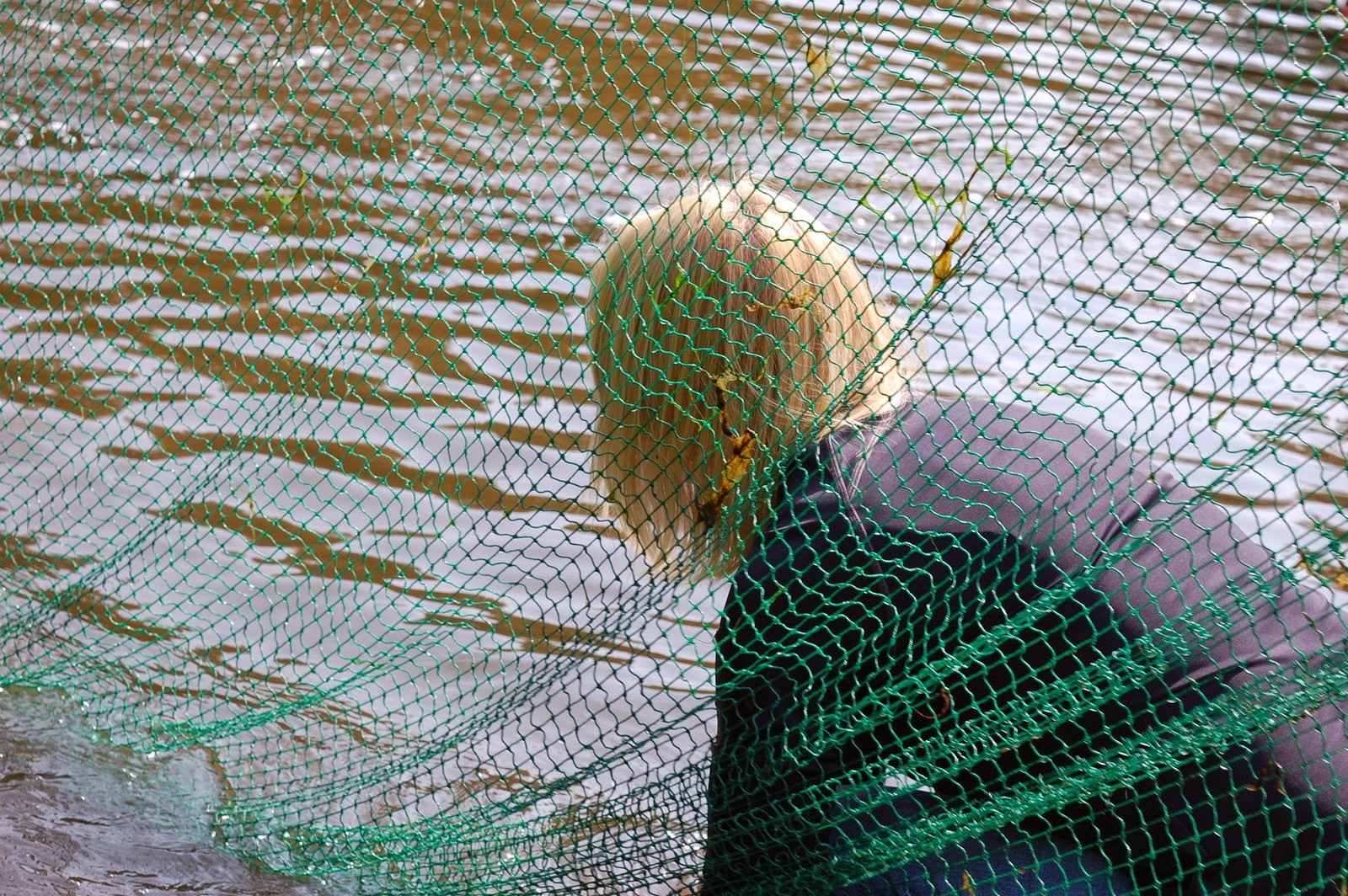

Wade at your own risk!


How do you determine the age of a fish? Measurement? Weight? They may be a rough estimate...but scientists do it by measuring a bone called an otolith, which has rings like the cross section of a tree!

For those really interested in citizen science, here is a link to the Atlantic Tarpon mitochondrial DNA, complete genome.

FWC biologist Dr Phil Stevens with a nice tarpon....hope it wasn't eating the really small ones!
What do tarpon eat?
The tarpon employs different feeding techniques depending upon its level of growth and development. Stage I larvae absorb nutrients directly from seawater through the integument. Zooplankton (copepods and ostracods), insects, and small fish compose the diet of stage II and III tarpon larvae and small juveniles. As tarpon grow, they move away from zooplankton as a chief food source and prey more exclusively on fishes (especially poecilids and cyprinodontids) and larger invertebrates such as shrimp and crabs. While juvenile tarpon are planktivorous, adult tarpon are strictly carnivorous and mostly feed on mid-water prey such as mullets, pinfish, marine catfishes, Atlantic needlefish, sardines, shrimp, and crabs. Tarpon feed during both day and night. Since the tarpon have minute teeth only, they usually swallow the prey whole
From the AtlanticPanic.com a great source of fish facts!

Field Biologist! Down and dirty....more time in the mud than on the computer keyboard!

Fin clipping to prevent counting the same fish twice. The fins grow back very quickly.
Here's a great site about marking and tagging fish for study. Lots more to it than I thought!

Data is recorded by retired FWC biologist, Chuck Idelberger
Keeping records is a key element of citizen science.

Lots more than tarpon at Wildflower.....

Eastern Mosquitofish (Gambusia holbrooki).

Fat Sleeper (Dormitor maculatus). Pet shops call it a Goby and will sell you one for your home aquarium.

Blue Crab (Callinectes sapidus)....I think! I will defer to the biologists on this one.
And...lots more to see that what's in the net!

Love this hatpin! Megalops comes from the Greek....big eye!
And here is the guy who named this noble fish

French zoologist, Achille Vallencienes. How's that for some trivia?

A flyby of American White Pelicans (Pelicanus erythrorhychos).

Red Mangrove (Rhizophora mangle) blossom

A couple of early spring butterflies.....a White Peacock (Anartia jatrophae).

Fiery Skipper (Hylephila phyleus) on Bidens alba Spanish Needle blossom.

Six-spotted Fishing Spider (Dolomedes triton).
What a great day with the Lemon Bay Conservancy volunteers and the biologists from Florida's FWC. Folks who care as much as these do wonders to preserve our natural world.

Just can't wait to get off this computer and back outside!