Monday, December 7, 2015

Barrier Island Walkabout with Lemon Bay Conservancy

The Lemon Bay Conservancy's Dr Bill Dunson recently hosted a naturalist walk on Manasota Key's Blind Pass Beach.  The cool, cloudy morning was perfect for some botany, ecology, geology, oceanography, ornithology, entomology...and interesting anecdotes.


wiki photo

Manasota Key is a barrier island on the SW coast of Florida.  Mostly developed, but with two very nice preserves....Stump Pass Beach State Park on the south end, and Blind Pass Beach Preserve in the center.


The first thing the group saw was a patch of Mother In Law's Tongue (Sansevieria trifasciata).   Invasive in the wild, this popular garden and houseplant has some interesting features:  selected by NASA to purify the air in future space stations, it is also good in homes as it absorbs nitrogen oxides and formaldehyde.  The flower which Dr Bill holds below has very long petals (corolla tube)  .....allowing only Sphynx moths to use their long probscises to reach the nectar and pollinate the plant.


If the are no Sphynx moths about, then this hardy plant is a rhizome and will propagate underground.

WOW....it's also a favorite for Feng Shui, as the leaves grow upward!  Brings good luck, money and clean air.

Bring some vibrant Qi into your home!


Off into the mangroves on the lee side of the island. 


Some White Mangrove trees (Avecennia germinans) which  are fast growing and the first to return to a disturbed area.


An unusual find!  Two Mangrove Salt Marsh Snakes (Nerodia clarkia compressicauda)  warming up in the sun.  Non-venomous and semi-aquatic.


The prettiest plant we saw, in my humble opinion, is the now out of favor, exotic, invasive.....but once popular as a ground cover..... Yellow Creeping Oxeye Daisy
 (Wedelia trilobata, Sphagneticola trilobata)
Now considered a Class 2 invasive, but I think they are beautiful and they are a good butterfly plant.

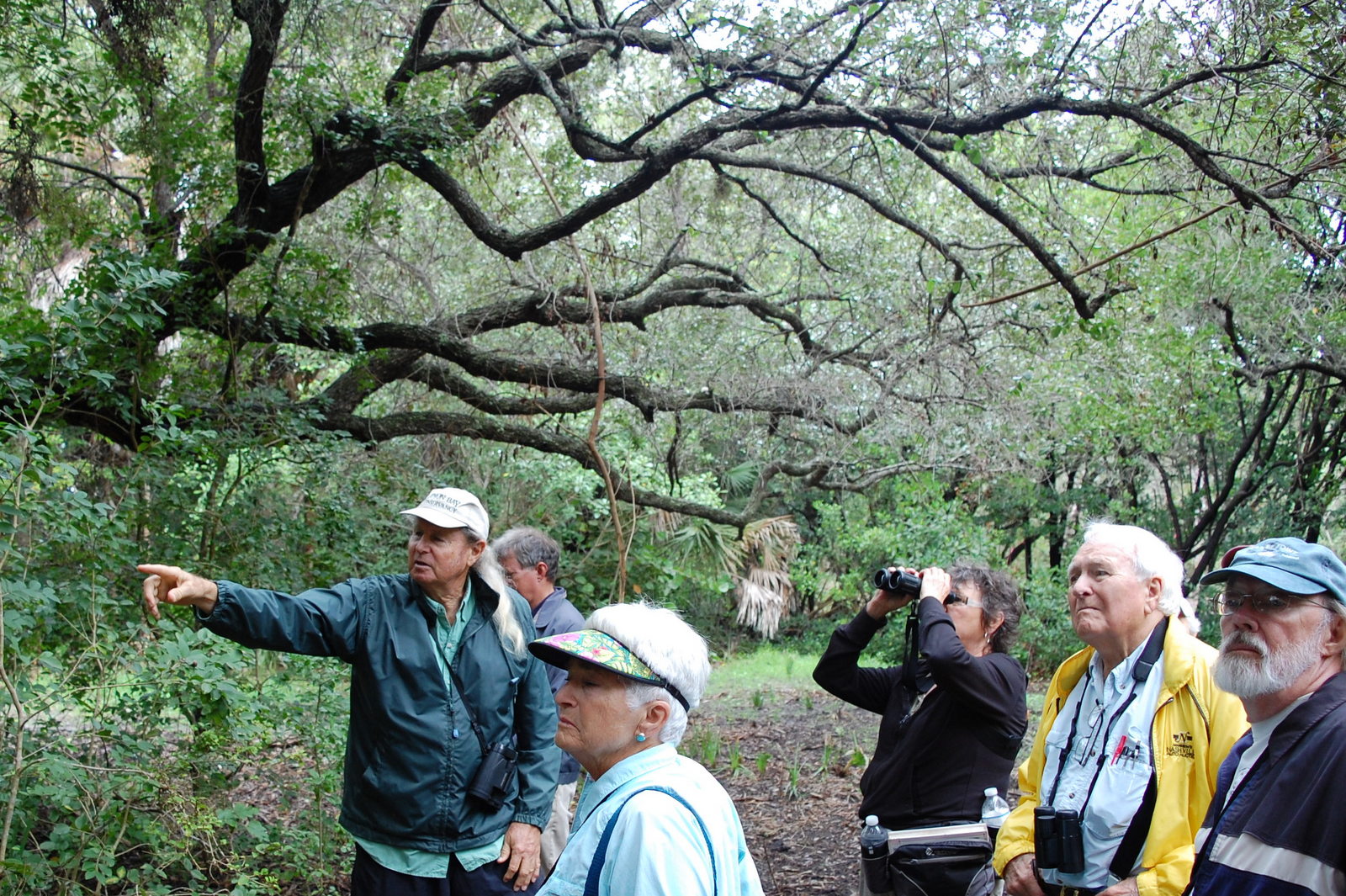


With even a small increase in elevation above sea level, we entered a hardwood hammock.  Dr Bill points out some features under the Live Oak (Quercus virginiana) canopy.


Back over to the Gulf of Mexico side of the key.  Dr Bill discussed the natural Gulf currents, shifting of sand, and constant changes of the shoreline.

Loop current in the Gulf of Mexico

wiki photo


 Longshore drift current


wiki photo


A bit of shell identification  Here, just a piece of a Lightning Whelk (Sinistrofulgur perversum).  What a great name!  Any Latin scholars out there?  I make it "A left sided bolt of lightning, in an unusual manner!"  What do you think?  It's been a long time since I studied Latin, and all I remember is...."Gallia est omnis divisa in partes tres..."


Some talk on bird migration and a few cooperative species on the beach.  A Snowy Egret (Egretta thula).


Red-breasted merganser (Mergus serrator)


Brown Pelican (Pelicanus occidentalis).


No....not the catch of the day....but some evidence of a recent Ride Tide fish kill.
 
 The dinoflagellate (Karenia brevis) which causes red tide.
wiki photo


 Most exciting find for me, a new species.....a flight of
White-tipped Black Moths (Melanchroia cephise)


These moths are the "parents" of the Snowbush caterpillar...considered enemy #1 of the imported Snowbush
(Breynia disticha) ornamental.


wiki photo
 

So....if you have a resident insect which attacks an imported ornamental.....do you kill the insect?   That's what the UF/Entomology Dept recommends.   And with Sevin yet!!!
Sevin is a broad spectrum insecticide which is banned in many countries as a carcinogen and associated with birth defects!!!!


What a great day....so much to see in varied environments and ecosystems....all in one barrier island.
Want to know more about Florida's natural beaches...


http://www.amazon.com/Floridas-Living-Beaches-Curious-Beachcomber/dp/1561643866


And be sure to check The Lemon Bay Conservancy's website for future outings.


Sunday, November 29, 2015

Green Lynx Spider (Peucetia viridans)

 Green Lynx Spider (Peucetia viridans).


This is a relatively large, bright green spider with long, spiny legs and lightning fast movements. They are typically spotted in shrubs and bushes during the day, where they are sit-and-wait predators. Incredibly, this spider is capable of “spitting” venom in self-defense
Above description from Spiders.US


Friday, November 20, 2015

Wild Orchids in the Flatwoods

Looking for terrestrial orchids makes a walk in the woods all the more interesting.  These photos are from a walk around the Spartina Marsh in Charlotte Flatwoods Environmental Preserve in Punta Gorda, Florida.
These photos, taken in mid-autumn show two elegant, but easily missed native orchids.
Above and below are Mignonette Orchids (Habenara floribunda).  Also called Toothed Rein Orchid, this species is found throughout central and south Florida.  Growing up to 100cm tall  with yellow-green labellum, it is likely found in wet areas like the flatwoods surrounding the marsh of the preserve.  We found dozens (a few at a time) during a 2 1/2 hour walk.


If you want to learn more about wild orchids, or to identify one you have seen....then be sure to visit the Go Orchids website link below.  It's AWESOME!


Florida's Flatwoods are a unique habitat for orchids.  Here is a website to learn more.


Photographing wild orchids is harder than you think.  Below is a website with some great tips.  Wife, Olivia, is a better spotter and has a steadier camera hand!


Lots of great "orchid walks" here in SW Florida.  Be sure to visit Charlotte Flatwoods if you are in the area.....and give me a shout and I'll join you!


This beauty was the highlight of the day.....
Long-lipped Ladies Tresses (Spiranthes longilabris).


The entire plant is only up to 50cm tall and not easy to spot amid grasses, pine straw and Saw Palmetto.


Endemic to the Southeast U.S. it has a lovely white inflorescence.


See how easy it would be to miss one of these.


Always a great day to be out in nature.  So much to see....God's work never ceases to amaze.

Tuesday, July 28, 2015

Field of Orchids

 It is always a thrill to find a wild orchid, but to find a field of them is truly exciting. 
Above is a Large Purple Fringed Orchis (Platanthera grandiflora).
The Field Guide, "Wild Orchids of the Northeastern United States," by Paul Martin Brown describes them... "widespread throughout the nine-state region, this tall (up to 1m), stately orchid is a summer feature, especially in northern New England.  It usually occurs in small numbers, often as a single plant, but every once in a while a large stand of more than 100 plants in found."


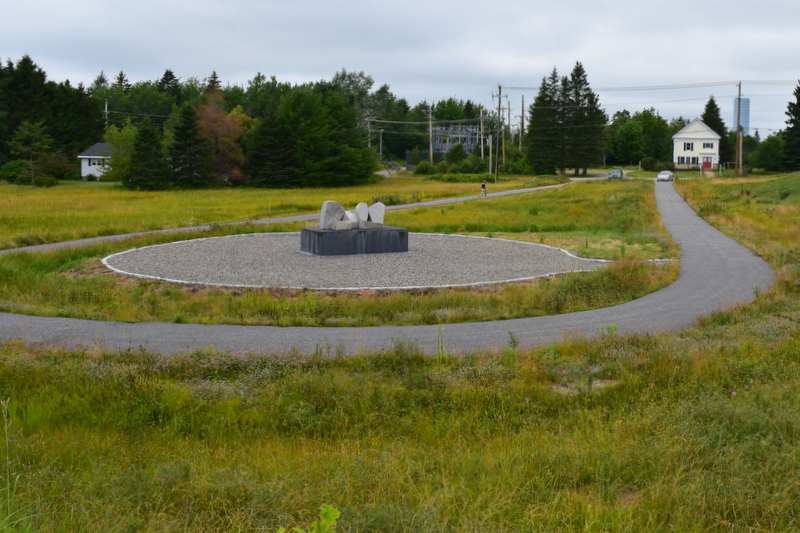
 Here in Harrington, Maine (a small coastal village along the scenic Bold Coast byway of Rt 1) has a park with over 200 in bloom!!!


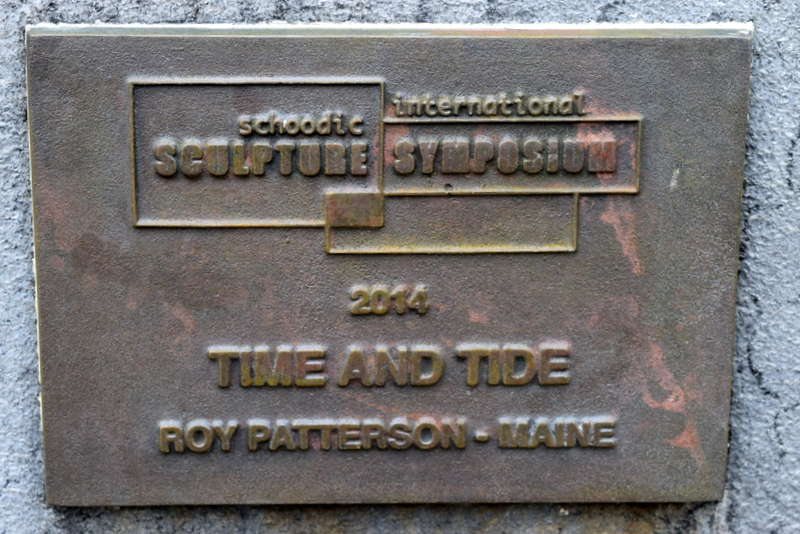
 The park also has a walking track and, as part of the Schoodic International Sculpture Symposium (2014), a large mounted sculpture.


 "Time and Tides" by Maine sculptor
Roy Patterson


 If you want to see more of Maine's sculptures, here's a map.


 The Northeastern US is blessed with many wild orchids.  Want to find more? 
 
Available on Amazon.com   You can get a used copy for 1 cent!!!


 Come along "Downeast" and see our beautiful orchids!  You will love them and take the time to look around Harrington....it's a great little village!


Friday, July 24, 2015

Rara avis in Downeast Maine

 Rufous Hummingbird (Selasphorus rufus), visiting our feeder here in Harrington, Maine today (7/24/2015).  Checked several sources and think this to be a rarity, but they have been seen in Maine before.


Cornell's range map....is this sighting just a stray?  Or is the range changing?  Maine doesn't seem to be on a likely migration route.


This feisty little guy was very aggressive toward the Ruby Throats who are the usual feeder guests.


 I reported the sighting on http://ebird.org/content/ebird/ ...I don't see any previous sightings on their map this far up the Maine Coast.


Hummingbirds are amazing and we feel very lucky to host this rare visitor!  
 

Tuesday, July 21, 2015

Boreal brook at Acadia National Park


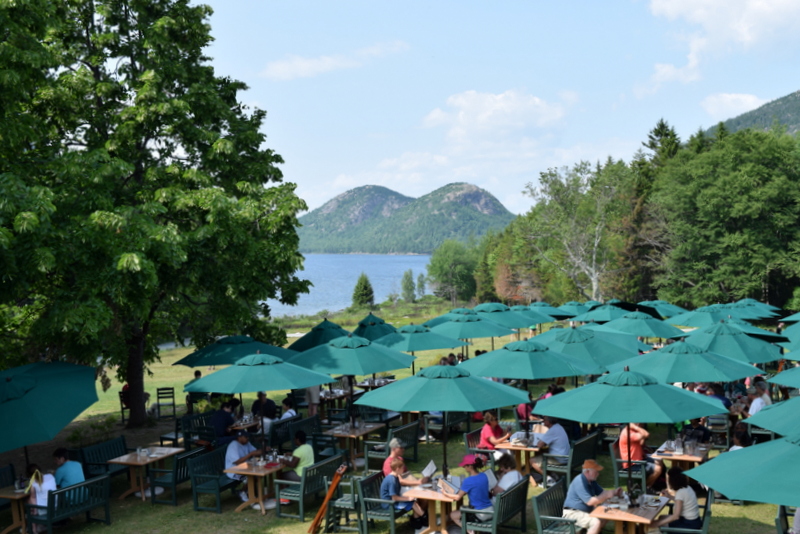
What to do with a few hours in Acadia National Park when it is mobbed by tourists....loud, rude, obnoxious tourists buying Chinese made junk souvenirs at the Jordan Pond House gift shop???
My answer is to attach the kit lens to the Nikon and find a spot without people....
Easy enough, just down the entrance road from Jordan Pond is Stanley Brook....scenic, quiet and very photogenic.
Just right for a bit of afternoon rusticating!
 

Stanley Brook makes it's way from Seal Harbor, through the forest to Jordan Pond.  Some trails cross it, but there are spots where you can enjoy it alone.


You can read all about Acadia's Carriage Roads and stone bridges.  Get a copy on Amazon.com


"Tea and Popovers" was the classic afternoon pastime for the early Acadia Carriage set.  Now crowded with ill-dressed, ill-behaved, ice cream eating, bused in, unpolished masses.....served by an equally rude and unpolished staff of Eastern Europeans....pressganged into an "American Holiday" by unscrupulous employment agencies.  Tantamount to human trafficking, albeit the result of unwillingness of our American youngsters to entertain such summer jobs.


The old Jordan Pond House....burned in the late 70's.  Gentile...simple....hot tea...no ice cream...no gluten free popovers...polite staff in white oxford shirts with towels over a forearm!  Anyone else remember?

Interior view.....great in early September with a fire in the fireplace.  Say, "Is that David Rockefeller at the far table?"


Thankfully, if you edit out the crowds....the view is the same!
 
It's a pretty spot...and Acadia is beautiful.  Just plan your visit after the crowds leave for the city.  I'm headed back Downeast to Washington County....."The Way Life Should Be."

Monday, July 6, 2015

Hummingbird Moth


Hummingbird Clearwing Moth  (Hemaris thysbe).
Often mistaken for a hummingbird, this diurnal moth is truly a sight to see.  The photo below was taken at 1/250 sec and the wings are blurry as this moth beats it's wings up to 300 times a second!!! And it can fly up to 37mph!