There is very little Primary Forest left in Southeast Asia. I had the great fortune to join some friends for a visit to an untouched bit of primary dipterocarp forest in Cuc Phuong National Park, Vietnam. The pristine state of this forest and national park is due to the vision of former President Ho Chi Minh, who in 1962, declared Cuc Phuong to be Vietnam's very first National Park. That was a troubled time for Vietnam, a young nation just out of a war with the French colonial forces, and beginning a civil war with the South Vietnamese and a war with the U.S. It is most remarkable that Bac (Uncle) Ho had the foresight to preserve such a valuable natural area.
Intrepid fellow trekkers and friends, (L to R) Vu Van Lien, Phil Gilbert, and son Ben. Lien, Phil and I have been friends since working with Lien's Earthwatch Research Project, Butterflies of Vietnam.
Cuc Phuong National Park has 20,200 hectares of primary forest among very steep limestone karst mountains.
In addition to the forest, there is the Endangered Primate Rescue Center, the Turtle Conservation Center, an Endangered Carnivore and Pangolin Center, and a 160 hectare Botanical Garden. The park has a hotel and restaurant at the entrance, and guest houses inside the park at Ho Mac Lake, where we stayed. After visiting all the conservation centers, we spent several days trekking in the forest...including an all-day treak over four karst mountains for an overnight homestay in a Muong stilt house in Khanh Village.
Cuc Phuong website....lots of info and photos
Below is the remains of an aged and giant Hallock or Jhalna Tree (Terminalia myriocarpa). This was the oldest tree in the park until a storm blew it down a few years ago. Our ranger guide said it was over a thousand years old.
"Dipterocarpaceae is a family of 17 genera and approximately 500 species of mainly tropical lowland rainforest trees. They are top canopy and understorey tree species. Many are large canopy forest emergent species, reaching some species heights of over 80 m tall. They are a pantropical group with more biodiversity from South East Asia to New Guinea. they are present in Africa, South America, India, Southeast Asia and Malesia"
Above is an exerpt from an excellent source website,
Several day's trekking through Cuc Phuong's forest trails brought us to some interesting spots, and worked up good appetites for the wonderful food at the guest house.
 Simple, but adequate accomodations at the guest house.
 We were happy with "Hot water and cold beer,"....and not the reverse!
The oldest tree in the park is a popular spot and an impressive, "grandfather."
Several busloads of students from Hanoi University came for a weekend visit. They were from the Natural Sciences Department, and their professor gave an "al fresco" lecture at the base of the Thousand Year Old Tree.
Much happens in the canopy that cannot be seen from the forest floor.
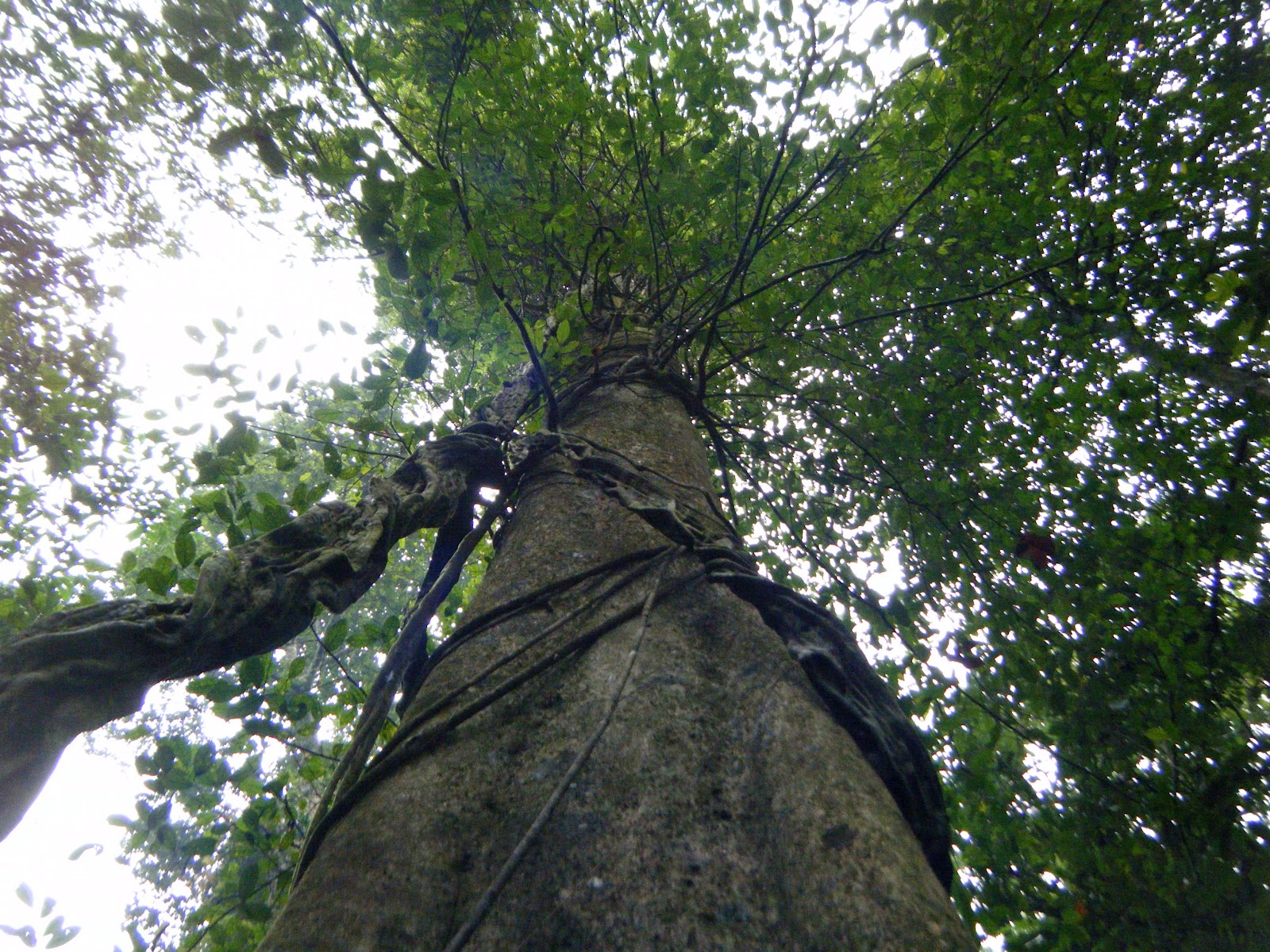
Many, many trees 30-40 meters tall. More than impressive...absolutely humbling.
Reconning the route to Khanh Village for our homestay with the Muong Hill Tribe.
It's not all rice paddies!
Vietnam's Rainforest info....great site!
On the long trek to Khanh Village, we had a forest ranger as guide who led us through the valleys and across the mountain passes.
But, there was still a lot of scrambling over the rocky outcroppings.
What a wonderful experience to walk silently through Asia's primary forest. Most of Asia's tropical hardwoods have long since been cut down.
Always interesting species along the way.
Lien and our Forest Ranger guide inspect a giant buttress root of a dipterocarp. These roots help stabilize the trees and provide more nutrients by extending the absorbtion area in the thin topsoil.
Bamboo groves were found in the valleys, and were difficult going.
Wild bananas, not the Cavendish cultivar you buy in the market. These are very small and bitter.....but forest birds and animals eat them.
The fourth karst range and last mountains to cross!
In the distance, Khanh Village......looks like Shangri-la after an all day trek
Before entering the village we came upon a small hidden valley with a herd of water buffalo. The villagers lead them into the valley via a small stream bed, then block off the entrance....and there they stay until it's time to plow.
The village has a timeless appearance, albeit with electricity.
Growing rice and corn.
Traditional houses on stilts, but now with concrete posts instead of tropical hardwood.....and with satellite dish TV!
.JPG) |
| photo courtesy of Ben and Phil Gilbert |
Dinner with our gracious host, Mr Nga....village chairman. The homestays provide income for the Muong people and give them a sense of ownership for the park....thus, they no longer log or poach game illegally.
 |
| photo courtesy of Ben and Phil Gilbert |
Lots of great food, cold Bia Hanoi and homemade rice whiskey out of an old water bottle!
.JPG) |
| photo courtesy of Ben and Phil Gilbert |
Sleeping arrangements were fine after a long, long trek and a modicum of rice whiskey. We all slept well.
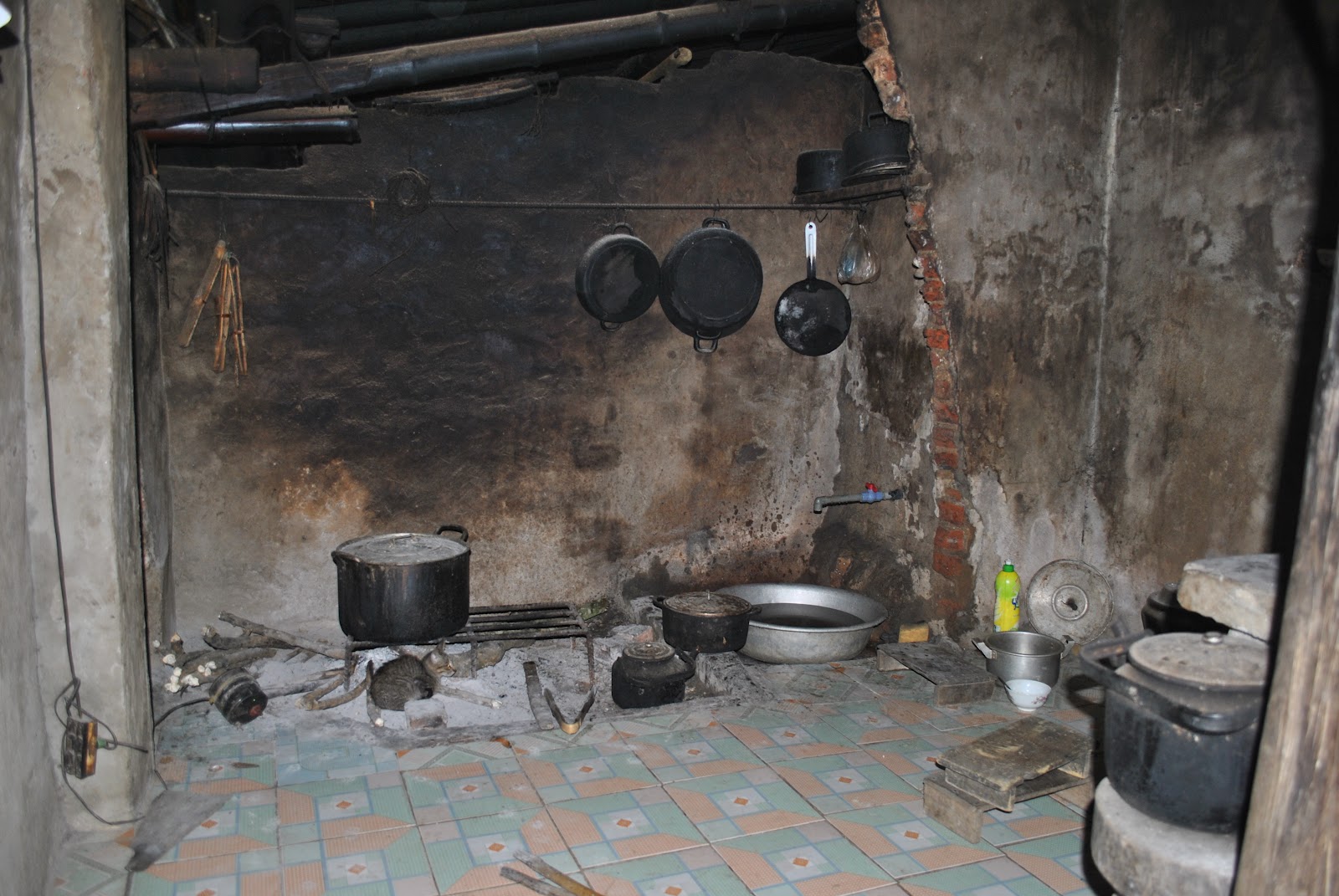
Mr Nga's wife and daughter in law prepared all that good food in this kitchen.
Finally, a look back through the mountains we trekked.
If you want to know more about Southeast Asia's forests, Richard Primack's tome is a good place to start.
Ready for the next adventure....maybe Bach Ma, or Cat Tien National Parks....


 Simple, but adequate accomodations at the guest house.
 We were happy with "Hot water and cold beer,"....and not the reverse!




.JPG)

.JPG)