Friday, March 29, 2013

Mangrove Skipper, Phocides pigmalion.

 The Mangrove Skipper (Phocides pigmalion) is a member of the Spread Wing Skippers of the Hesperidae family of butterflies.


 Found in the Mangrove forests of Florida, this large (48-70mm wingspan) skipper is a strong flyer and is often seen perching upside down with spread wings.


The iridescent blue markings are beautiful and, along with it's size and perching posture, make identification easy.
 

Monday, March 25, 2013

Limpkin, a Tropical Wading Bird in the U.S..


The Limpkin (Aramus guarauna) is a tropical wading bird with Florida being the northern limit of it's traditional range.  Hunted to near extinction in the early 20th century, the Limpkin has made a remarkable comeback.  


These photos were taken in a fresh water canal in my "very suburban" neighborhood.  I believe these birds are a mating pair and I will keep observing them to see if they produce any chicks.
 

 Found near fresh water in all of peninsular Florida, there are increasing reports of sightings in Georgia and the Carolinas.  I wonder if this is an adaptation to global warming, increased population....and I have a real suspicion that diet change has not only increased Limpkin distribution, but also it's numbers.


All of the books, websites and field guides state that Limpkins feed almost exclusively on Apple Snails (Pomacea spp),  but this pair has been eating Asian Clams (Corbicula fluminea).  Apple Snails are a native Florida species, while the Asian Clam is an exotic and invasive!  Hmmm....what a wonderful adaptation....expanding it's diet to consume large numbers of readily available invasives.  I hope that biologist readers will consider this and comment!


The fresh water lakes, ponds and canals are replete with Asian Clams....a species brought here from SE Asia early in the 20th century...either inadvertently or as a food source by immigrant Asians.
 

This pair has been busy digging clams out of the muddy shallows....the banks of the canal are littered with dozens of shells.


This is an Apple Snail.....I have seen Limpkins feeding on them at the Celery Fields in Sarasota.


The call of the Limpkin is both unique and famous.....a loud and rather raucous crying sound, heard most often at night, or at dawn.  These birds are mostly nocturnal....guess I was lucky to observe them during the day.  The Limpkin call was used in many Tarzan movies (for jungle sounds)....and most recently, a recording from Cornell University's extensive bird call collection was used for Harry Potter's, Hippogryph!!!


A 28" tropical, fresh water, wading bird.....where do you suppose it's taxonomy lies?  Scientists ponder and disagree, but the consensus seems to put them in a family of their own, most closely related to cranes.


 Here's is Aububon's painting of a Limpkin.  The very unnatural pose reminds one that he generally killed the bird and then painted it's lifeless body.  Acceptable for his time I guess, but certainly not now.
 
 
Birding in Florida is just wonderful....many great places, and many species found in unlikely places and easily observed.


I'll be watching this pair.....and for a nest.  The books are really vague about nesting behavior......"nests found on the ground, in the reeds near water, in bushes, or in trees up to 20' off the ground...or higher!"
 
If you want to join me, drop me an e-mail......I'd love to share this birding opportunity.


Thursday, March 21, 2013

Romalea microptera, Eastern Lubber Grasshopper

Grasshoppers are common insects.  Often seen and heard during the warmer months here in the U.S., they are symbolic of summer and outdoor activities.  In Florida the Eastern Lubber (Romalea microptera) is our most observed species.  They are large (3 inches), brightly colored, flightless and slow moving.

Lubber's distribution is in the "U.S Subtropics," as you can see by the map


When we begin to see them in the spring, they are small black nymphs with yellow stripes.  They moult through five instars and as they do, they change color to the yellow/orange with black spots in the first photo.  Above, this "teenager" is growing bigger, but still dark colored.

Being "popular" insects, grasshoppers were studied long ago!


Grasshoppers are herbivorous, and although harmless to humans, some can do significant damage to crops.  Want to know more about our insect world....get a copy of the "Field Guide to Insects of North America," by my Facebook friend, Eric Eaton.


Here's another book I liked.


Fabled in story, song and even poetry.....here's a grasshopper ode!


The Grasshopper

Grasshopper
grasshopper
all day long
we hear your scraping
summer song
like
rusty
fiddles
in
the
grass
as through
the meadow
path
we pass
such funny legs
such funny feet
and how we wonder
what you eat
maybe a single blink of dew
sipped from a clover leaf would do
then high in air
once more you spring
to fall in grass again
and sing.

Below is a Lubber growing larger, but still black with yellow stripes.


Some taxonomists argue for Romalea gutatta.


See if you can find the grasshopper in this classic Hokusai painting!

And here is a cohort of young lubber instars!


Tuesday, March 5, 2013

Palmedes Swallowtail

 Spring butterflies are starting to appear in SW Florida.  This Palmedes Swallowtail (Paplilo palmedes) was seen patrolling the woodline on the Seaboard Grade in the Babcock-Webb WMA in Punta Gorda on March 5, 2013.


The Swamp Bay and Red Bay are it's host plant, but this one was seen basking on Saw Palmetto.


Monday, March 4, 2013

Burrowing Owl

The Burrowing Owl (Athene cunicularia) is North America's only raptor that nests underground.   There are local and spotty populations here in SW Florida, with habitat loss being the greatest threat to these small owls.  Here's a link to the Burrowing Owl Conservation Society, with a nice video.
 

Nine inches tall, with a wingspan of 21 inches, Burrowing Owls are diurnal, and can be spotted sitting atop or near their borrows.  In Florida, they are a "species of special concern," and are protected from all hunting and burrow disturbance.  Many burrows in SW Florida are marked like the one below, and some are even supplied with handy perches.


With an estimated 3000 Burrowing Owls in Florida, Cape Coral has the largest population.  The city has an annual "Burrowing Owl Festival," offers tours and even has an Owl Cam so you can watch a burrow on your computer!!!   Here's a link to their site....be sure to see some of these little birds when you are in SW Florida
 

Monday, February 25, 2013

Florida Mottled Duck

 
The Florida Mottled Duck (Anas fulvigula fulvigula) is a medium sized dabbling duck, closely related to the Mallard and American Black Duck.  This is a subspecies of two distinct populations of Mottled Ducks, the other being A. fulvigula maculosa found along the Gulf of Mexico between Alabama and Tamaulipas (Mexico).
The Florida Duck is non-migratory and found mainly south of Tampa.  Both sexes appear similar, with the male having a more distinctly yellow bill.
 

Monday, February 11, 2013

Yellow Rat Snake at Fakahatchee Strand

This Yellow Rat Snake (Paantheropis obsoleta quadrivittata) was spotted along a trail in the Fakahatchee Strand Preserve State Park.  This is an arboreal species, usually found high up in Cypress trees.


 Fakahatchee Strand Preserve State Park is a unique linear swamp forest...some 20 miles long and 5 miles wide.  Located on the western edge of Big Cypress Preserve, it is part of the Western Everglades region of Southern Florida.


Below is a trail map of the park.  Visiting L.A. photographer (and son) Andy J Scott AndyJScott.com and I hiked up the East Main Trail to the old ranger's cabin.  Here's a link to the Friends of Fakahatchee Strand website.  Be sure to watch the video of all the wildlife spotted in the preserve.


The trail is an old road with swamp on both sides.....we hiked in January so it was dry.... most of the year it is under water.


Most of the alligators are in deep "gator holes" this time of year, but some still prowl the swamp.


White Ibis (Eudocimus albus), known locally as
Chockoloskee Chicken, are a common Floridian wading bird.  They were hunted for food by early settlers and glades hermits.


Being favored habitat of Florida's State Butterfly, the Zebra Longwing (Heliconius charitonius), we saw quite a few along the trail's edge.


L.A. photographer switching his camera "scene dial" from urban to nature!


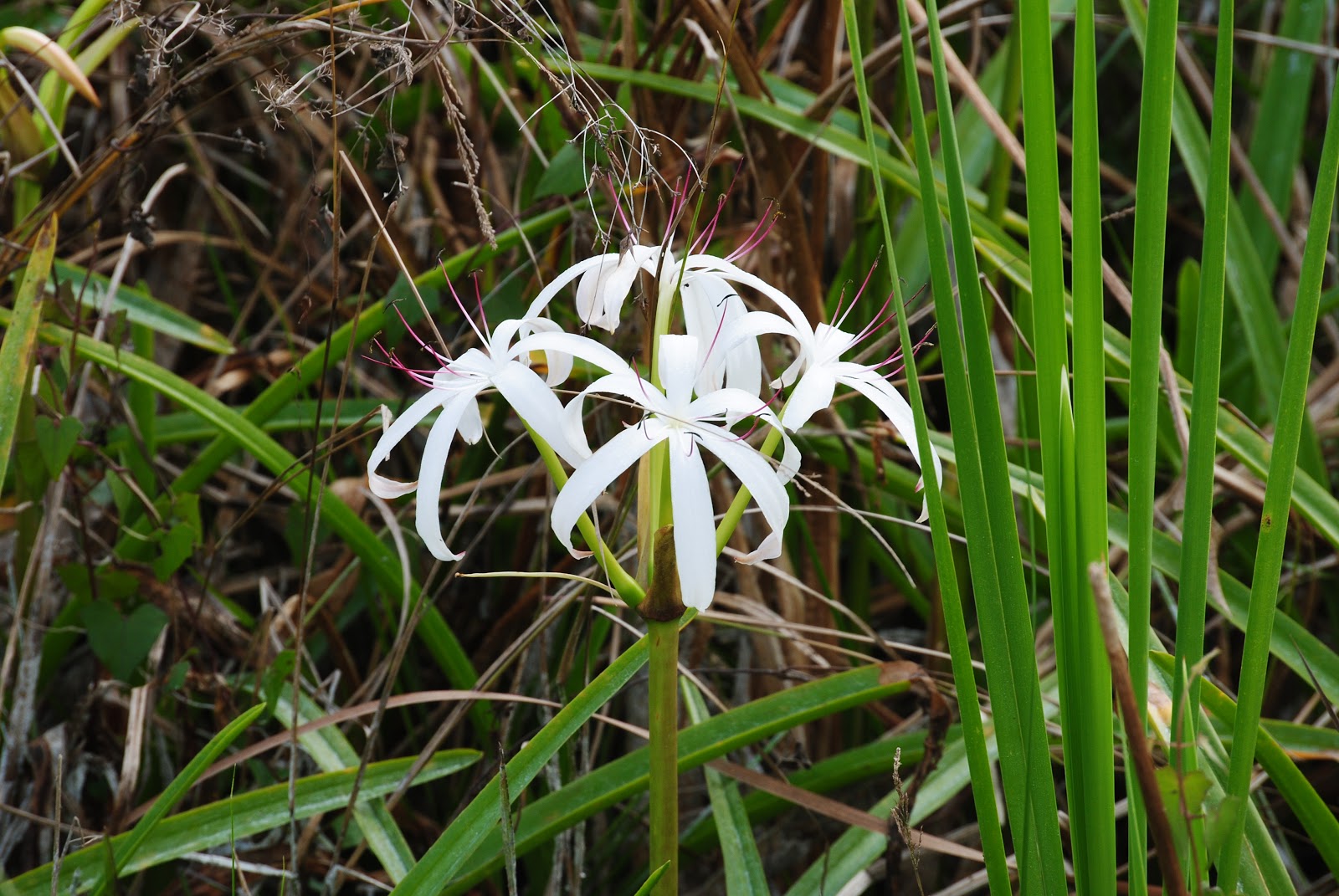
January is not the season for orchid blooms, but we did see this beautiful Swamp Lily...a beautiful invasive.


I felt very lucky to spot this rather tattered
Ruddy Daggerwing (Marpesia petreus).


Didn't see any panthers on the trail, but thought we were on the set of "Deliverance" when we got to the old ranger's cabin!


Nice little gator hole behing the cabin.  Lots of small gators and turtles.


I love the plaque on the old cabin!
 

On the way back down the trail we saw some blooming Bromeliads. 


Quill-Leaf (Tillandsia fasciculata).  Related to Pineapples and usually found growing on cypress and pine trees.


Bell-weather of the Glades, the Wood Stork (Mycteria americana).


A triple bloom Quill-leaf!  I'll be back later this year to look for blossoming orchids.  Here's a link to a great video about Fakahatchee Strand's Ghost Orchids.


After our hike we headed down the road to the Big Cypress HQ to look for some big gators.  We were not disappointed!


Such remarkable and ancient creatures....almost hunted to extinction....now thriving in South Florida.


The viewing boardwalks in Big Cypress are great for gator and turtle watching.  Above is a Cooter....I believe it's a
Pond Cooter (Pseudomys floridana).


Florida Softshelled Turtle (Apalone ferox).


These big boys love to "tomando el sol!"  One and all, they were bigger than my 12 foot kayak!


Shadows grow long....time to head home and reflect on another wonderful day, "Swampin'" in the glades.


Lots to see and do in wild Florida.  Come visit...and keep your eyes open!